
Out-of-School Children by Country: 2024 World Rankings
Children out of school are the number of primary-school-age children not enrolled in primary or secondary school. Data from the World Bank.
Nigeria has the highest number of out-of-school children of primary age: 9.1M in 2023. Next are Pakistan (5.4M), Ethiopia (4.2M), Angola (2.3M, 2023) and Tanzania (2.0M). The Turks and Caicos Islands has the lowest number of out-of-school children of primary age: 4 in 2024. The median across the 177 countries is 17,362, counting each country once, so it is not a world average.
Source: World Bank World Development Indicators. 177 of 218 countries and territories have a figure. Each country shows its latest available year, from 2021 to 2025. The most common is 2024 (109 of 177 countries).
- Highest
- 9.1M
- Nigeria, 2023
- Lowest
- 4
- Turks and Caicos Islands, 2024
- Median
- 17,362
- Counting each country once, so it is not a world average
- Coverage
- 177 of 218
- Countries and territories with a figure; latest available, 2021 to 2025
- Sum of the table
- 26.3M
- Sum of 109 countries with 2024 figures, not an official world figure
| # | Country | Out-of-School Children, Primary | Year | Change since 2014 (%) |
|---|---|---|---|---|
| 1 | Nigeria | 9.1M | 2023 | n/a |
| 2 | Pakistan | 5.4M | 2024 | n/a |
| 3 | Ethiopia | 4.2M | 2024 | +31.0% |
| 4 | Angola | 2.3M | 2023 | n/a |
| 5 | Tanzania | 2.0M | 2024 | +20.1% |
| 6 | Niger | 1.9M | 2024 | +41.9% |
| 7 | Philippines | 1.6M | 2024 | +17.7% |
| 8 | Burkina Faso | 1.4M | 2024 | +31.6% |
| 9 | South Sudan | 1.2M | 2024 | n/a |
| 9 | Mali | 1.2M | 2023 | -4.3%2014 to 2023 |
| 11 | United States | 965,853 | 2022 | n/a |
| 12 | Bangladesh | 918,575 | 2024 | n/a |
| 13 | Chad | 855,041 | 2024 | n/a |
| 14 | Senegal | 675,615 | 2024 | +23.6% |
| 15 | Burundi | 661,724 | 2025 | +339.7%2014 to 2025 |
| 16 | Côte d'Ivoire | 650,800 | 2024 | -42.0% |
| 17 | Syria | 581,845 | 2024 | n/a |
| 18 | Egypt | 559,709 | 2024 | -67.6% |
| 19 | Kenya | 468,923 | 2023 | n/a |
| 20 | South Africa | 448,146 | 2023 | n/a |
| 21 | Malaysia | 404,724 | 2024 | +76.6% |
| 22 | Honduras | 346,452 | 2024 | +24.9% |
| 23 | Zimbabwe | 332,314 | 2024 | +18.3% |
| 24 | Liberia | 327,280 | 2022 | -29.4%2014 to 2022 |
| 25 | Brazil | 316,818 | 2024 | -52.7% |
| 26 | Mauritania | 291,098 | 2024 | +64.6% |
| 27 | Colombia | 289,295 | 2022 | n/a |
| 28 | Indonesia | 250,575 | 2025 | -73.9%2014 to 2025 |
| 29 | Ghana | 235,313 | 2024 | -40.1% |
| 30 | Benin | 213,285 | 2022 | +243.6%2014 to 2022 |
| 31 | Guatemala | 201,342 | 2024 | -8.1% |
| 32 | Ukraine | 193,775 | 2024 | -3.0% |
| 33 | Russia | 187,975 | 2023 | +16.4%2014 to 2023 |
| 34 | Eritrea | 179,166 | 2022 | +24.7%2014 to 2022 |
| 35 | Cameroon | 173,924 | 2024 | -6.4% |
| 36 | Republic of the Congo | 171,125 | 2023 | n/a |
| 37 | Romania | 160,246 | 2023 | n/a |
| 38 | Sri Lanka | 157,499 | 2023 | +35.8%2014 to 2023 |
| 39 | Lebanon | 146,896 | 2024 | -8.7% |
| 40 | Vietnam | 144,562 | 2024 | +507.3% |
| 41 | Zambia | 136,539 | 2024 | n/a |
| 42 | Bolivia | 136,027 | 2024 | -12.6% |
| 43 | Madagascar | 135,621 | 2024 | +99.3% |
| 44 | India | 134,967 | 2025 | n/a |
| 45 | Kazakhstan | 128,155 | 2025 | +27.9%2014 to 2025 |
| 46 | Canada | 127,666 | 2023 | +1090.0%2014 to 2023 |
| 47 | Lesotho | 124,175 | 2024 | +129.5% |
| 48 | Paraguay | 105,859 | 2024 | n/a |
| 49 | Ecuador | 86,090 | 2023 | +283.8%2014 to 2023 |
| 50 | Laos | 82,273 | 2025 | +179.1%2014 to 2025 |
| 51 | Algeria | 78,683 | 2025 | +384.7%2014 to 2025 |
| 52 | Cambodia | 76,741 | 2024 | -53.8% |
| 53 | The Gambia | 74,577 | 2025 | -32.6%2014 to 2025 |
| 54 | Malawi | 70,758 | 2022 | n/a |
| 55 | Mozambique | 64,247 | 2022 | -66.8%2014 to 2022 |
| 56 | El Salvador | 57,339 | 2024 | +23.4% |
| 57 | Dominican Republic | 56,334 | 2024 | -35.6% |
| 58 | West Bank and Gaza | 53,793 | 2023 | +112.4%2014 to 2023 |
| 59 | Nicaragua | 53,481 | 2023 | n/a |
| 60 | Papua New Guinea | 53,289 | 2021 | -86.1%2014 to 2021 |
| 61 | Italy | 52,117 | 2023 | +49.0%2014 to 2023 |
| 62 | Mexico | 46,859 | 2024 | +10.5% |
| 63 | Solomon Islands | 36,440 | 2024 | +1300.5% |
| 64 | Thailand | 36,067 | 2025 | n/a |
| 65 | Panama | 35,837 | 2024 | +4.8% |
| 66 | Mongolia | 35,209 | 2024 | +170.2% |
| 67 | Spain | 34,050 | 2024 | -54.9% |
| 68 | Cuba | 33,328 | 2024 | +118.1% |
| 69 | Argentina | 32,816 | 2023 | +288.3%2014 to 2023 |
| 70 | Türkiye | 32,563 | 2023 | +134.0%2014 to 2023 |
| 71 | Chile | 31,779 | 2024 | -25.5% |
| 72 | Israel | 28,644 | 2024 | +652.8% |
| 73 | Turkmenistan | 28,415 | 2024 | n/a |
| 74 | Cabo Verde | 24,851 | 2022 | +691.4%2014 to 2022 |
| 75 | Oman | 21,922 | 2024 | +258.3% |
| 76 | Puerto Rico | 21,785 | 2024 | +58.0% |
| 77 | Comoros | 21,743 | 2024 | +226.6% |
| 78 | Jordan | 21,351 | 2024 | n/a |
| 79 | Georgia | 21,241 | 2024 | +176.2% |
| 80 | Nepal | 21,146 | 2025 | -34.2%2014 to 2025 |
| 81 | Belarus | 20,600 | 2024 | +257.7% |
| 82 | Costa Rica | 19,701 | 2024 | -52.8% |
| 83 | Rwanda | 19,504 | 2024 | n/a |
| 84 | Morocco | 18,988 | 2021 | -93.5%2014 to 2021 |
| 85 | Kyrgyzstan | 18,854 | 2025 | -6.9%2014 to 2025 |
| 86 | Uzbekistan | 18,501 | 2025 | -67.6%2014 to 2025 |
| 87 | Venezuela | 17,643 | 2023 | -92.4%2014 to 2023 |
| 88 | Saudi Arabia | 17,458 | 2024 | -89.5% |
| 89 | Guyana | 17,362 | 2023 | n/a |
| 90 | Bulgaria | 14,529 | 2024 | +71.2% |
| 91 | Tunisia | 14,015 | 2023 | +58.4%2014 to 2023 |
| 92 | Belgium | 13,226 | 2023 | -3.7%2014 to 2023 |
| 93 | Timor-Leste | 13,085 | 2023 | +0.5%2014 to 2023 |
| 94 | Suriname | 10,697 | 2024 | -4.2% |
| 95 | Hungary | 10,500 | 2024 | -16.8% |
| 96 | New Zealand | 10,396 | 2024 | +207.7% |
| 97 | Ireland | 10,313 | 2022 | +5135.0%2014 to 2022 |
| 98 | Jamaica | 9,419 | 2024 | -68.9% |
| 99 | Togo | 9,263 | 2024 | -91.2% |
| 100 | Trinidad and Tobago | 9,223 | 2024 | n/a |
| 101 | Iran | 9,163 | 2023 | -96.8%2014 to 2023 |
| 102 | Germany | 8,820 | 2024 | -74.3% |
| 103 | Serbia | 8,749 | 2024 | +155.6% |
| 104 | Qatar | 8,638 | 2024 | +14.5% |
| 105 | Bhutan | 8,385 | 2024 | n/a |
| 106 | France | 8,155 | 2024 | -85.5% |
| 107 | Eswatini | 7,275 | 2022 | -69.5%2014 to 2022 |
| 108 | Finland | 6,433 | 2024 | +36.3% |
| 109 | Norway | 6,077 | 2024 | +242.6% |
| 110 | Bahrain | 5,993 | 2024 | +1015.3% |
| 111 | Netherlands | 5,698 | 2023 | n/a |
| 112 | Austria | 5,200 | 2024 | +23.8% |
| 113 | Belize | 4,953 | 2024 | +2057.5% |
| 114 | Czechia | 4,700 | 2023 | -46.2%2014 to 2023 |
| 115 | Macao | 4,608 | 2024 | +314.8% |
| 116 | Bahamas | 4,585 | 2024 | n/a |
| 117 | Hong Kong | 4,491 | 2024 | +85.1% |
| 118 | Sweden | 4,270 | 2024 | -48.1% |
| 119 | Namibia | 4,230 | 2024 | +3.8% |
| 120 | Japan | 4,225 | 2023 | -24.6%2014 to 2023 |
| 121 | North Macedonia | 4,151 | 2023 | -5.0%2014 to 2023 |
| 122 | Denmark | 3,868 | 2024 | +35.7% |
| 123 | Curaçao | 3,547 | 2024 | n/a |
| 124 | Latvia | 3,481 | 2024 | +53.9% |
| 125 | Barbados | 3,420 | 2024 | +194.1% |
| 126 | United Kingdom | 3,326 | 2023 | -95.6%2014 to 2023 |
| 127 | Micronesia | 3,301 | 2024 | +72.8% |
| 128 | Estonia | 3,091 | 2024 | +59.9% |
| 129 | Bosnia and Herzegovina | 2,933 | 2023 | -83.2%2014 to 2023 |
| 130 | Australia | 2,833 | 2024 | +91.4% |
| 131 | Portugal | 2,741 | 2023 | -42.0%2014 to 2023 |
| 132 | Croatia | 2,642 | 2023 | +13.2%2014 to 2023 |
| 133 | Slovakia | 2,535 | 2024 | -81.6% |
| 134 | Fiji | 2,471 | 2024 | -71.8% |
| 135 | Slovenia | 1,904 | 2023 | -12.5%2014 to 2023 |
| 136 | Botswana | 1,869 | 2022 | -95.3%2014 to 2022 |
| 137 | Armenia | 1,710 | 2024 | -86.3% |
| 138 | Kiribati | 1,596 | 2024 | +2521.5% |
| 139 | Brunei | 1,438 | 2024 | +200.2% |
| 140 | Poland | 1,392 | 2024 | -98.5% |
| 141 | South Korea | 1,383 | 2024 | -98.3% |
| 142 | Vanuatu | 1,261 | 2024 | n/a |
| 143 | British Virgin Islands | 1,080 | 2024 | +377.9% |
| 144 | St. Lucia | 1,033 | 2024 | -28.4% |
| 145 | Switzerland | 787 | 2024 | +1233.9% |
| 146 | Malta | 738 | 2023 | +129.9%2014 to 2023 |
| 147 | Seychelles | 699 | 2024 | n/a |
| 148 | Samoa | 626 | 2024 | +1041.7% |
| 149 | Greece | 622 | 2023 | -96.6%2014 to 2023 |
| 150 | Mauritius | 618 | 2024 | -89.6% |
| 151 | Albania | 617 | 2024 | -13.1% |
| 152 | Iceland | 599 | 2023 | +68.3%2014 to 2023 |
| 153 | Moldova | 588 | 2024 | +122.9% |
| 154 | Grenada | 535 | 2024 | -1.2% |
| 155 | Singapore | 504 | 2023 | n/a |
| 156 | Maldives | 418 | 2024 | -78.6% |
| 157 | Tonga | 354 | 2022 | n/a |
| 158 | Cyprus | 247 | 2023 | -82.0%2014 to 2023 |
| 159 | Cayman Islands | 234 | 2024 | n/a |
| 160 | Dominica | 230 | 2023 | +8.0%2014 to 2023 |
| 161 | Sint Maarten | 196 | 2023 | n/a |
| 162 | Lithuania | 156 | 2024 | +126.1% |
| 163 | Azerbaijan | 152 | 2024 | -95.8% |
| 164 | Antigua and Barbuda | 133 | 2023 | +392.3%2014 to 2023 |
| 165 | Nauru | 119 | 2025 | +3.5%2014 to 2025 |
| 166 | Luxembourg | 111 | 2024 | -89.9% |
| 167 | Andorra | 102 | 2024 | -76.7% |
| 168 | Uruguay | 98 | 2023 | -99.3%2014 to 2023 |
| 169 | San Marino | 91 | 2024 | n/a |
| 170 | Montenegro | 80 | 2023 | n/a |
| 171 | Marshall Islands | 78 | 2024 | n/a |
| 172 | Gibraltar | 43 | 2024 | n/a |
| 173 | United Arab Emirates | 21 | 2024 | n/a |
| 174 | Palau | 18 | 2024 | -35.4% |
| 175 | Liechtenstein | 16 | 2021 | -63.6%2014 to 2021 |
| 176 | Tuvalu | 7 | 2024 | -72.8% |
| 177 | Turks and Caicos Islands | 4 | 2024 | -98.9% |
Each figure is the latest available for that country, so rows can refer to different years; compare years before comparing values. n/a means the source has no figure for that country in that column. Values are rounded for display; the CSV download has full precision.
41 countries and territories have no figure
Afghanistan, American Samoa, Aruba, Bermuda, Central African Republic, Channel Islands, China, Djibouti, DR Congo, Equatorial Guinea, Faroe Islands, French Polynesia, Gabon, Greenland, Guam, Guinea, Guinea-Bissau, Haiti, Iraq, Isle of Man, Kosovo, Kuwait, Libya, Monaco, Myanmar, New Caledonia, North Korea, Northern Mariana Islands, Peru, Saint Martin, Sao Tome and Principe, Sierra Leone, Somalia, St. Kitts and Nevis, St. Vincent and the Grenadines, Sudan, Taiwan, Tajikistan, U.S. Virgin Islands, Uganda, Yemen.
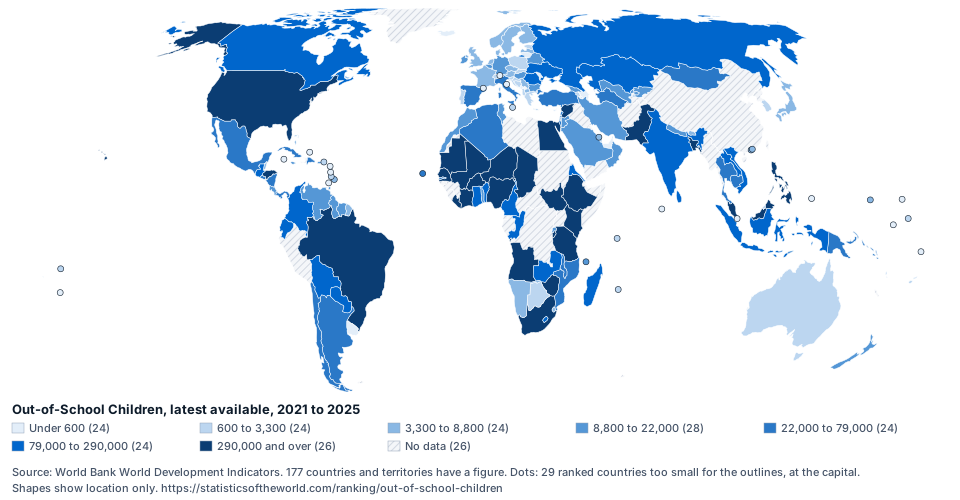
Embed this map
<a href="https://statisticsoftheworld.com/ranking/out-of-school-children"><img src="https://statisticsoftheworld.com/maps/SE.PRM.UNER.svg" width="960" height="500" alt="World map of number of out-of-school children of primary age, latest available, 2021 to 2025. Source: World Bank World Development Indicators."></a>
<p>Source: World Bank World Development Indicators. Map: <a href="https://statisticsoftheworld.com/ranking/out-of-school-children">Statistics of the World</a></p>
Then and now
| # | 2000 | 2014 | 2024 |
|---|---|---|---|
| 1 | India (13.9M) | Ethiopia (3.2M) | Nigeria (9.1M, 2023) |
| 2 | Nigeria (7.2M) | Sudan (3.1M) | Pakistan (5.4M) |
| 3 | Ethiopia (6.9M) | Egypt (1.7M) | Ethiopia (4.2M) |
| 4 | Tanzania (2.9M) | Tanzania (1.7M) | Angola (2.3M, 2023) |
| 5 | Kenya (1.9M) | Philippines (1.4M) | Tanzania (2.0M) |
| 6 | Mozambique (1.6M) | Niger (1.3M) | Niger (1.9M) |
| 7 | Côte d'Ivoire (1.5M) | Mali (1.2M) | Philippines (1.6M) |
| 8 | Egypt (1.4M) | Côte d'Ivoire (1.1M) | Burkina Faso (1.4M) |
| 9 | Iran (1.4M) | Burkina Faso (1.0M) | South Sudan (1.2M) |
| 10 | South Africa (1.4M) | Indonesia (959,679) | Mali (1.2M, 2023) |
Kiribati rose the most since 2014, +2521.5%, among the 88 countries with figures for both 2014 and 2024. The Turks and Caicos Islands fell the most, -98.9%.
Rose the most since 2014
- Kiribati: +2521.5%
- Belize: +2057.5%
- Solomon Islands: +1300.5%
- Switzerland: +1233.9%
- Samoa: +1041.7%
Fell the most since 2014
- Turks and Caicos Islands: -98.9%
- Poland: -98.5%
- South Korea: -98.3%
- Azerbaijan: -95.8%
- Togo: -91.2%
From the change column: countries whose latest figure is for 2024 and that have a 2014 figure.
By region
| Region | Countries | Highest | Lowest | Median, each country counted once | Sum of same-year figures |
|---|---|---|---|---|---|
| East Asia & Pacific | 29 | Philippines (1.6M) | Tuvalu (7) | 4,225 | 2.3M (20 countries, 2024) |
| Europe & Central Asia | 51 | Ukraine (193,775) | Liechtenstein (16, 2021) | 4,151 | 389,538 (29 countries, 2024) |
| Latin America & Caribbean | 35 | Honduras (346,452) | Turks and Caicos Islands (4) | 17,643 | 1.5M (25 countries, 2024) |
| Middle East, North Africa, Afghanistan & Pakistan | 17 | Pakistan (5.4M) | United Arab Emirates (21) | 21,351 | 6.8M (11 countries, 2024) |
| North America | 2 | United States (965,853, 2022) | Canada (127,666, 2023) | 546,760 | |
| South Asia | 6 | Bangladesh (918,575) | Maldives (418) | 78,057 | 927,378 (3 countries, 2024) |
| Sub-Saharan Africa | 37 | Nigeria (9.1M, 2023) | Mauritius (618) | 213,285 | 14.4M (21 countries, 2024) |
A regional sum adds the countries with 2024 figures; it is not an official regional figure.
Where major economies rank
- United States: 965,853 in 2022, rank 11 of 177.
- India: 134,967 in 2025, rank 44 of 177.
- Japan: 4,225 in 2023, rank 120 of 177.
- Germany: 8,820 in 2024, rank 102 of 177.
- United Kingdom: 3,326 in 2023, rank 126 of 177.
- France: 8,155 in 2024, rank 106 of 177.
- Brazil: 316,818 in 2024, rank 25 of 177.
- Canada: 127,666 in 2023, rank 46 of 177.
- Nigeria: 9.1M in 2023, rank 1 of 177.
About these figures
Definition. Children out of school are the number of primary-school-age children not enrolled in primary or secondary school. (The publisher's definition of “Children out of school, primary”, copied from the World Bank (World Development Indicators) on 2026-09-07.)
Unit. children
Coverage. 177 of 218 countries and territories have a figure. Each country shows its latest available year, from 2021 to 2025. The most common is 2024 (109 of 177 countries).
The median and any other summary on this page count each country once, so they are not world averages. Values are rounded for display; the CSV download has full precision.
The publisher revises past years when it updates the series, so a figure here can change after it first appears.
Questions about these figures
Which country has the highest number of out-of-school children of primary age?
Nigeria has the highest number of out-of-school children of primary age: 9.1M in 2023. The figures come from the World Bank World Development Indicators.
Which country has the lowest number of out-of-school children of primary age?
The Turks and Caicos Islands has the lowest number of out-of-school children of primary age: 4 in 2024.
How many countries are ranked, and for which years?
177 countries and territories have a figure in this ranking. Each country shows its latest available year, from 2021 to 2025. The most common is 2024 (109 of 177 countries).
What is the median number of out-of-school children of primary age across countries?
The median is 17,362: half of the 177 countries are above it and half below. The most common year of the figures is 2024. It counts each country once, so it is not a world average.
How much of the combined total do the largest countries account for?
Among the 109 countries with 2024 figures, the ten largest account for 76.7% of their combined total.
Which country's number of out-of-school children of primary age changed the most since 2014?
Among the 88 countries with figures for both 2014 and 2024, Kiribati changed the most: +2521.5% since 2014, to 1,596 in 2024.
Where does the United States rank on number of out-of-school children of primary age?
The United States ranks 11 of 177, at 965,853 in 2022.
Which country has the highest number of out-of-school children of primary age in each region?
East Asia & Pacific: the Philippines (1.6M); Europe & Central Asia: Ukraine (193,775); Latin America & Caribbean: Honduras (346,452); Middle East, North Africa, Afghanistan & Pakistan: Pakistan (5.4M); North America: the United States (965,853, 2022); South Asia: Bangladesh (918,575); Sub-Saharan Africa: Nigeria (9.1M, 2023). Figures are for 2024 unless another year is shown. Regions follow the World Bank's groups.
Use and cite this data
- The download button above saves this table's rows as CSV, filtered and in the order shown. The API also serves this indicator as CSV: statisticsoftheworld.com/api/v1/rankings/SE.PRM.UNER?format=csv. It lists the stored latest figures highest first under the publisher's country names and can include the World aggregate, so its rows and ranks can differ from this table.
- Licence: CC BY 4.0. Attribution is required; dataset-specific notices and third-party restrictions still apply. Source terms.
- The map above can be embedded: open "Embed this map" under it for code that links back to this page.
- Each country has its own row link, such as https://statisticsoftheworld.com/ranking/out-of-school-children#NGA.
- Spotted an error? Report a data correction. How to cite: citation guide.
Statistics of the World. Out-of-School Children by Country: 2024 Rankings. Data: World Bank World Development Indicators, figures for 2021 to 2025. https://statisticsoftheworld.com/ranking/out-of-school-children
Use this data programmatically
Fetch the same 177-country ranking as JSON or CSV: fresh on every request, drop-in for dashboards, scripts, and notebooks. 1,000 free requests/day, no signup needed; sign up for usage tracking and 50,000/day on Pro.
curl 'https://statisticsoftheworld.com/api/v1/rankings/SE.PRM.UNER?format=csv' \
  -o out-of-school-children.csv